
Disc golf is a game of inches, especially when it comes to putting. We all have our favorite putters, but does stability really make a difference inside Circle 1? I set out to answer that question with a head-to-head comparison between the stable Prodigy PA-3 and the understable Prodigy PA-5.
The Setup:
On a crisp February morning, I braved the 32-degree temperatures at FDR State Park in Yorktown, NY, to conduct this experiment. Thankfully, the wind was negligible, which helped minimize external variables. My goal was simple: to see which putter reigned supreme within the crucial 33-foot Circle 1.
I used two Prodigy putters:
- PA-3: A stable putter (3/3/0/1, 172g) known for its straight flight and minimal fade.
- PA-5: An understable putter (3/4/-2/0.5) designed to turn and finish with a gentle fade.
The Trials:
To ensure a thorough test, I implemented three different trial methods:
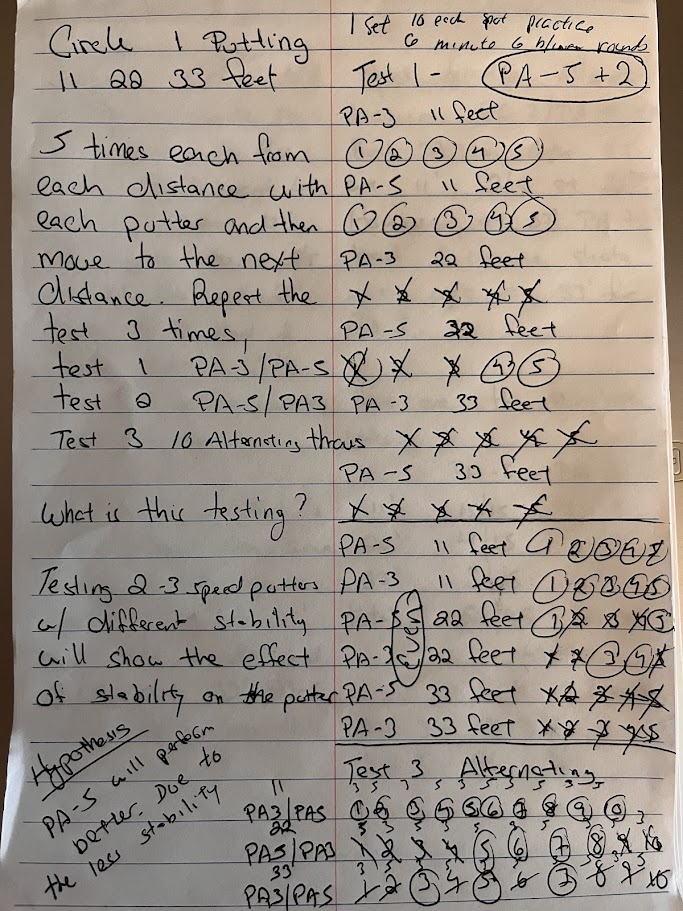
- Trials 1 & 2: 5 Throws Each Putter at One Distance, then move to the next length. At 11ft, 22ft, and 33ft, I threw five putts with the PA-3, then five with the PA-5. This was repeated at each distance.
- Trial 3: Ten consecutive putts at each distance, alternating between the PA-3 and PA-5 (PA-3, PA-5, PA-3, PA-5, etc.) to simulate a more realistic putting scenario.

The Results:
Here’s a breakdown of the results:
| Putter | 11′ (Made/Attempted) | 22′ (Made/Attempted) | 33′ (Made/Attempted) | Total Made | Overall Percentage |
|---|---|---|---|---|---|
| PA-3 | 15/15 | 4/15 | 3/15 | 22/45 | 48.9% |
| PA-5 | 15.15 | 6/15 | 0/15 | 21.15 | 46.7% |
The Analysis:
At first glance, the PA-3 appears to have a slight edge. However, raw numbers don’t tell the whole story. To determine if this difference was statistically significant, I performed a McNemar’s test. This test is perfect for analyzing paired data like this, where each thrower used both putters.
The results of the McNemar’s test showed a high p-value (well above 0.05). In layman’s terms, this means that while the PA-3 had a marginally higher overall make percentage, this difference could easily be due to random chance. Statistically, we can’t definitively say the PA-3 is more accurate based on this experiment.
The Takeaway:
This experiment, conducted in chilly 32-degree weather at FDR State Park, didn’t provide conclusive evidence that one putter is significantly better than the other inside Circle 1. While the PA-3 showed a slightly higher make percentage, the statistical analysis suggests this difference isn’t significant.
It’s important to remember that putting is highly personal. Individual putting styles, preferences, and even the specific conditions on a given day can influence results. This experiment, while informative, only scratches the surface. Larger sample sizes and more controlled environments could provide more definitive answers.
Complete Lab Report can be found in the file below:
What are your experiences with these putters? Let me know in the comments below!
advanced disc golf approach shots beginner disc golf circle 1 putting data analysis dgpt disc golf disc golf blog disc golf community disc golf discs disc golf equipment disc golf gear disc golf news disc golf science disc golf strategy discraft dynamic discs equipment testing flight science innova intermediate disc golf kastaplast latitude 64 lone star discs mvp pa-3 pa-5 pdga prodigy prodigy pa-3 prodigy pa-5 putter comparison putter review putters putting putting accuracy putting drills putting form putting practice putting technique putting tips stable putter statistical analysis understable putter Westchester
 Blue Jay Disc Golf - Flight Science
Leave a comment